01
Demurrage
The container sits in the terminal past its last free day. The clock started when the vessel discharged, and nobody in the office watched it start.
For South African container transporters
Software for your container jobs, trucks and drivers that shows each deadline before it costs you. Being built now — not live yet.
01 · The problem
01
The container sits in the terminal past its last free day. The clock started when the vessel discharged, and nobody in the office watched it start.
02
The empty is still out. The clock started when the truck took the container out of the gate, and it runs until the empty is back at the right depot.
03
The shipping line nominated a depot. The driver goes to a different one. The container comes back, the day is gone, and the charge lands anyway.
Demurrage
Vessel discharges → last free day → it starts costing.
Detention
Out the gate, full → empty due back → it starts costing.
A container has two clocks. An abnormal load has a permit that lapses, an export a stack that closes. All of it is knowable before it costs anything — a spreadsheet can hold the dates, it cannot watch them.
02 · What it does
One record of each job, shared by the office, the phones and your client. Most of it is built and tested now; none of it is live yet, and each part below says where it stands.
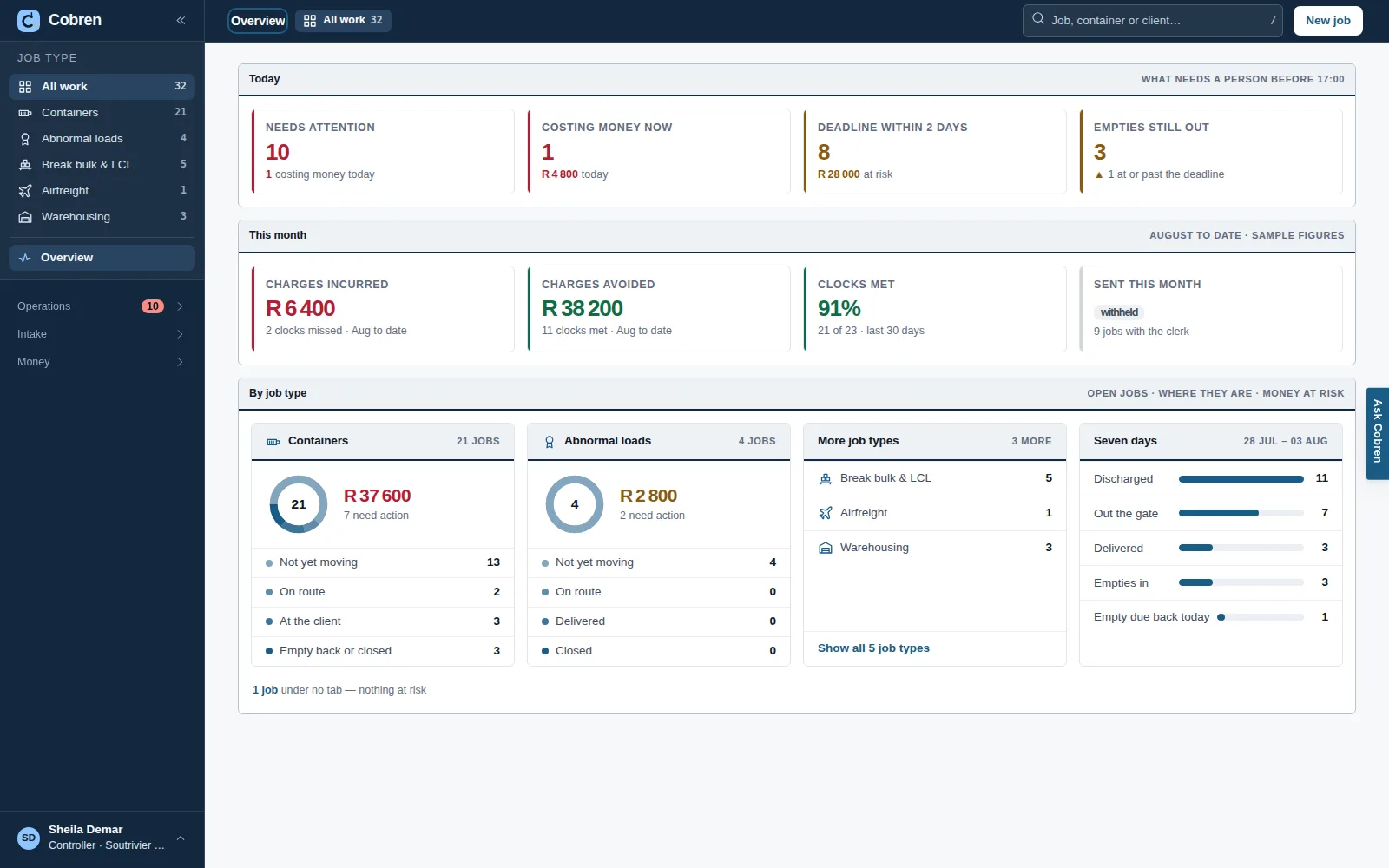
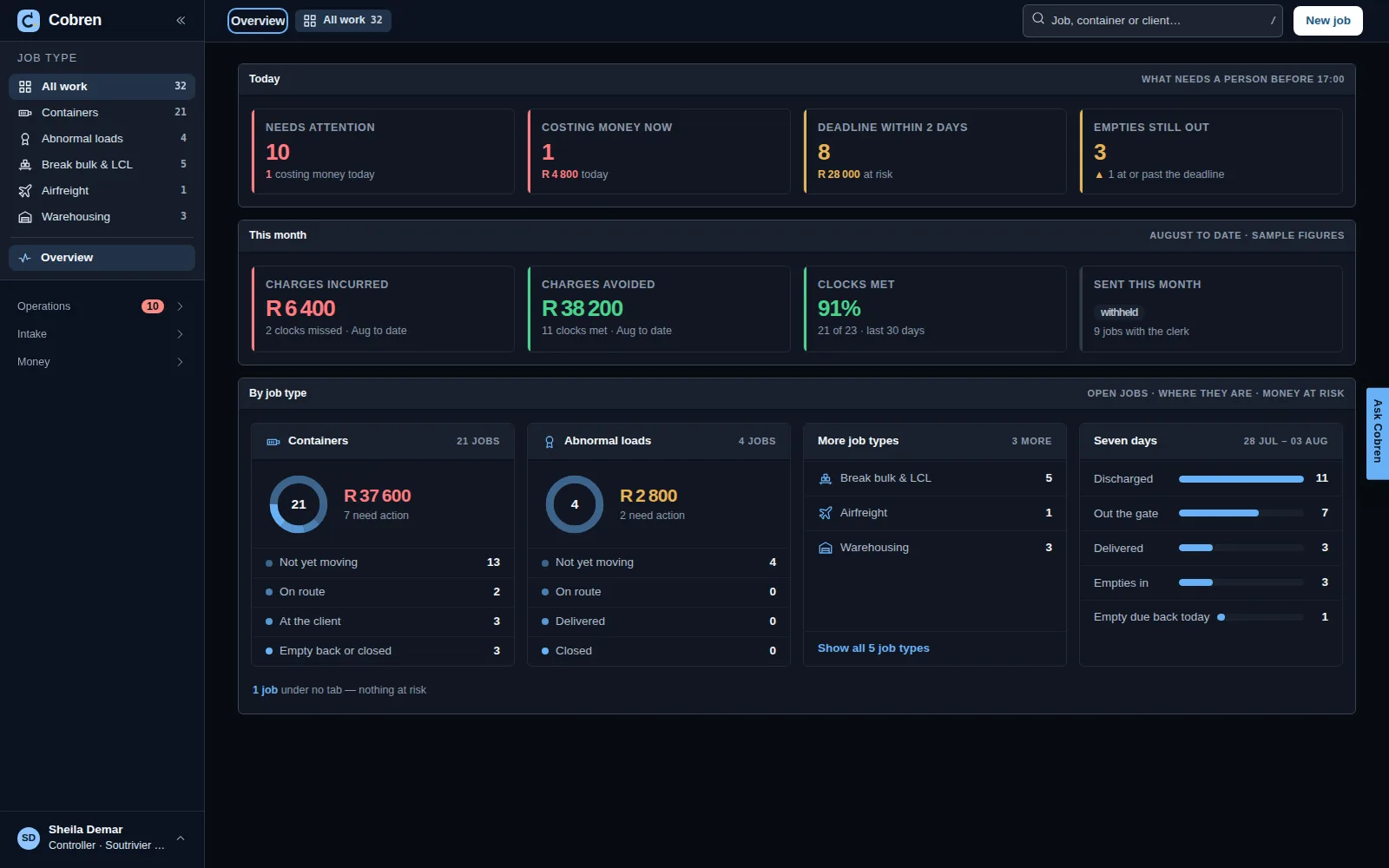
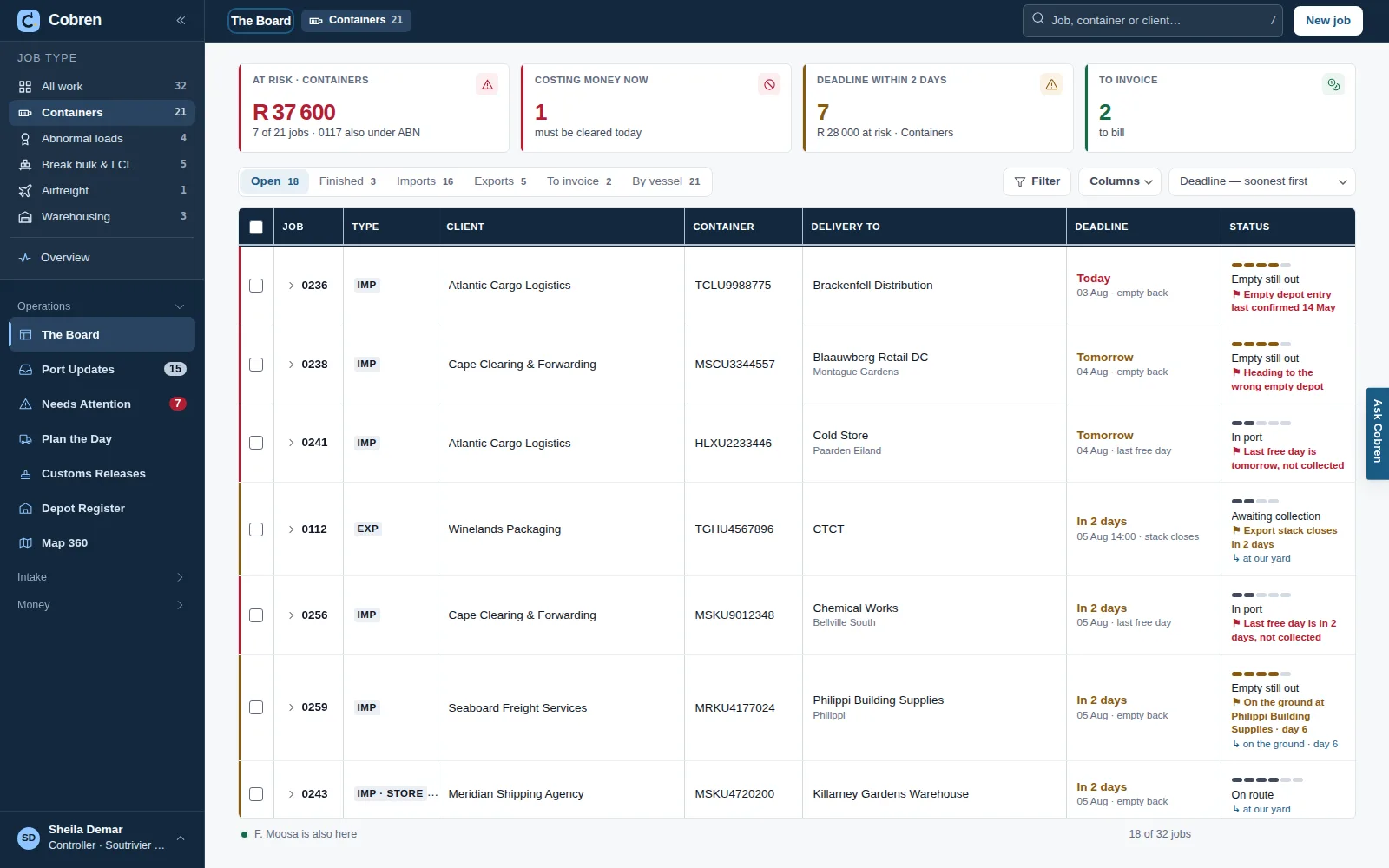
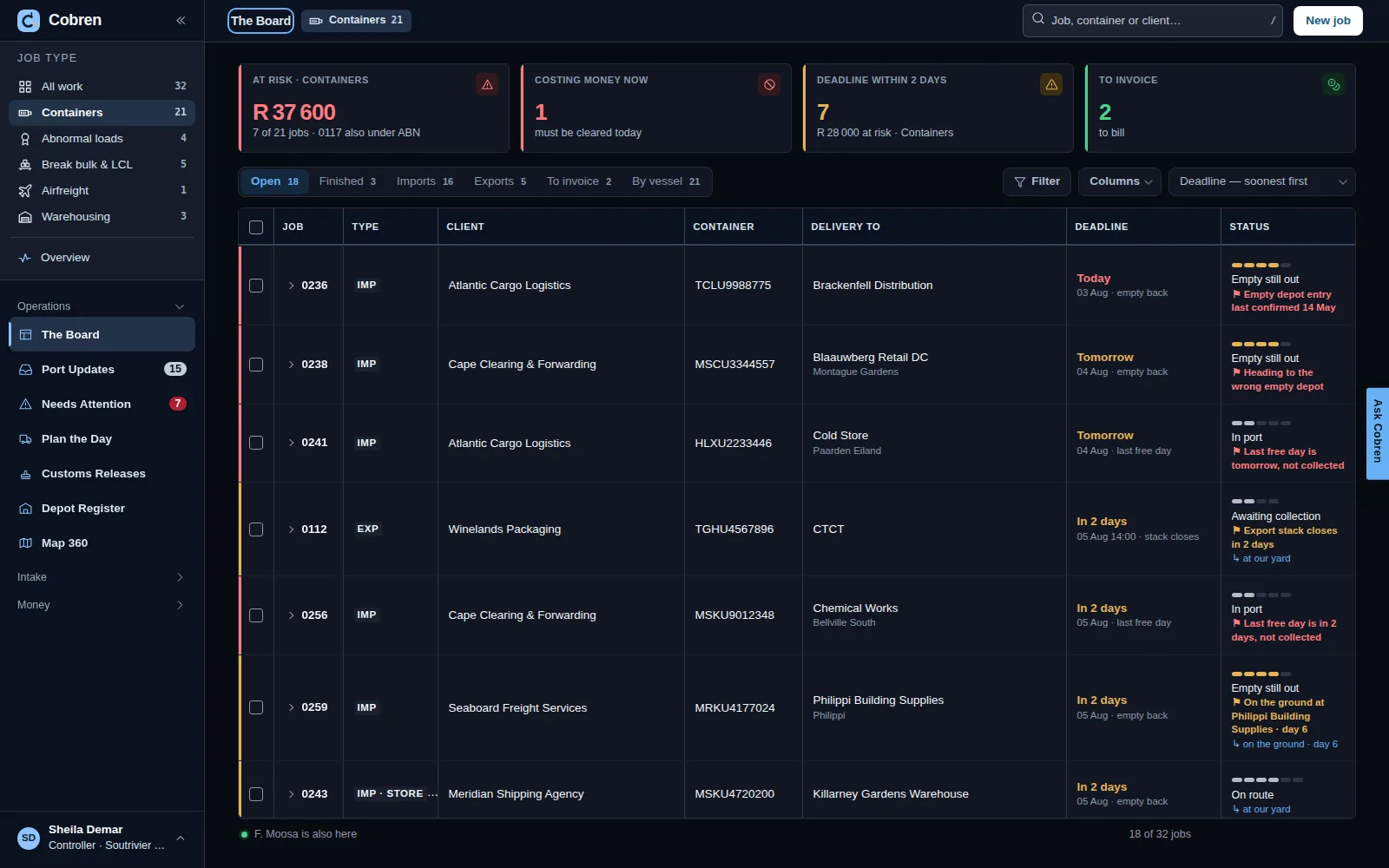
Every open job, with the deadline that binds first in its own column and which deadline it is beside the date — a stack closing, a last free day, an empty due back. Sorted by what costs money soonest, and it says where a container is standing: at our yard, or on the ground at the client and for how many days. Built in the application and tested against a real database; not live yet.
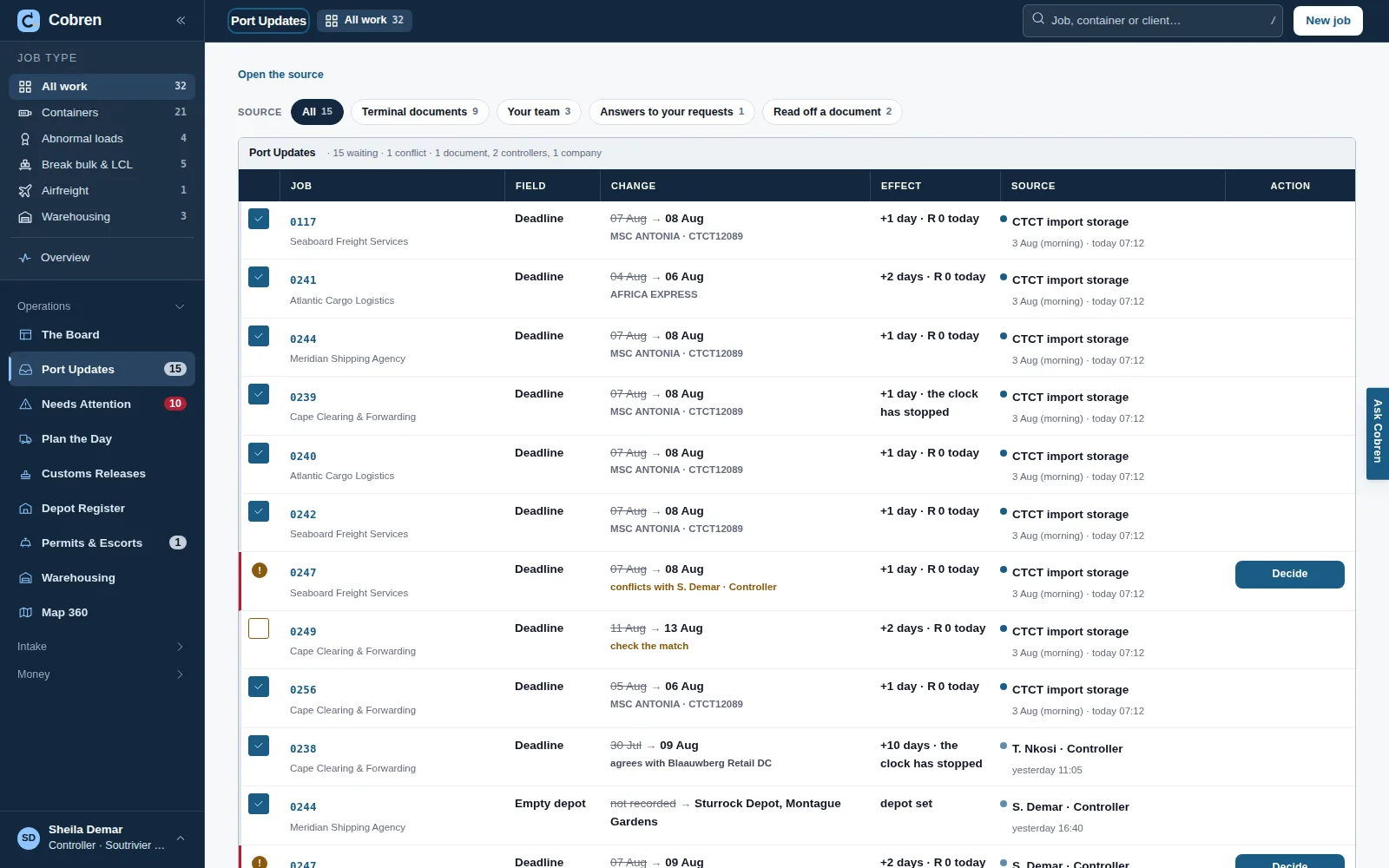
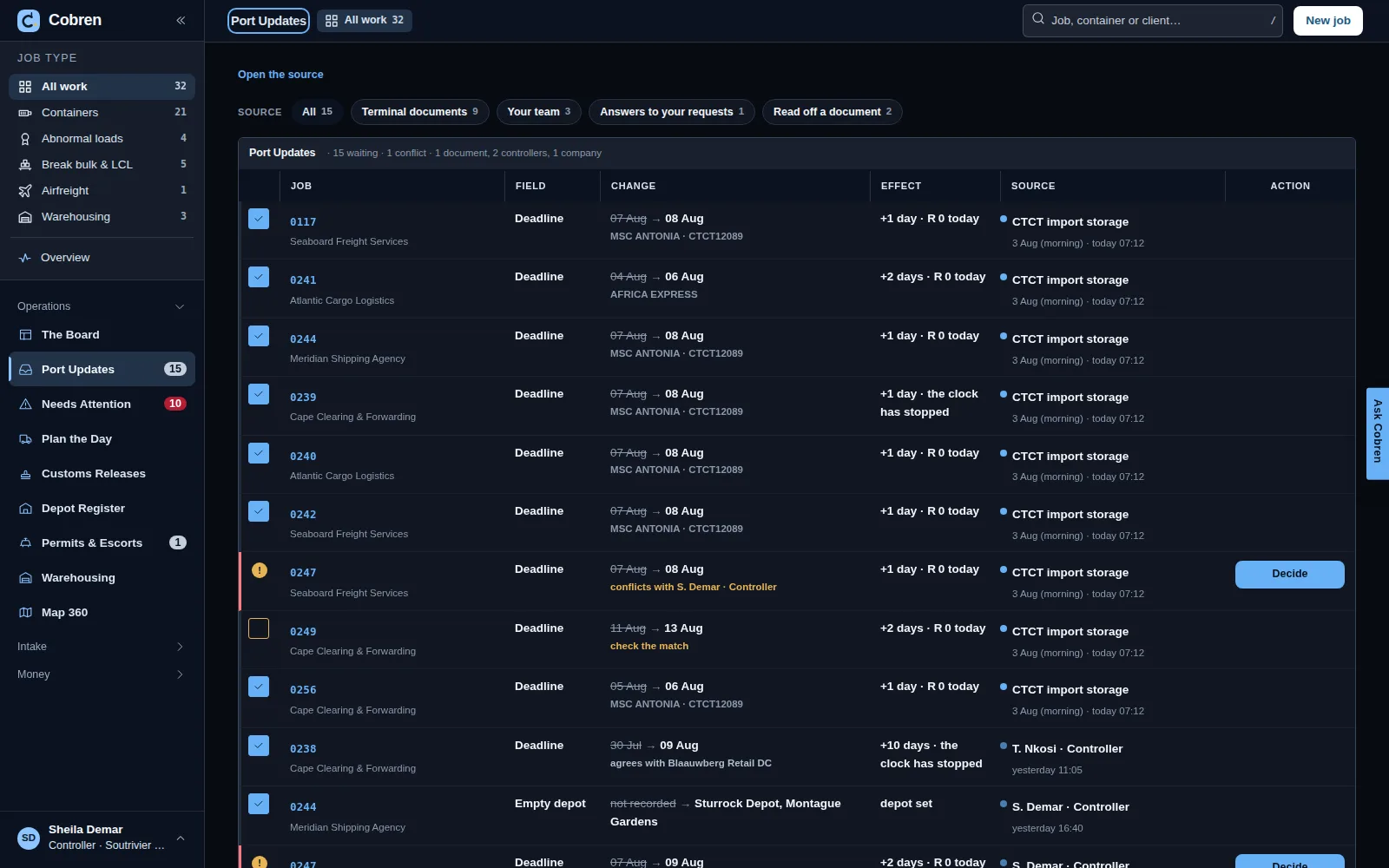
Transnet publishes each container terminal’s lists — import storage, stack dates, berthing. Cobren reads the newest list for each terminal, one request at a time, keeps it exactly as published, and puts each change it makes to your jobs on Port Updates: the old date, the new one, what it does to the deadline, and where it came from. A person ticks and accepts; nothing changes a job by itself. What your controllers propose by hand, and what a client, depot or delivery site answers to a request you sent, wait in the same list. Built and tested against Transnet’s real lists; not live yet, so nothing has been collected.
Port to your yard, into store for a few days, yard to the client, the empty back to the depot. The job type decides the stages: containers, abnormal loads, break bulk & LCL, airfreight or warehousing. Each stage has its own truck, driver and carrier — your own fleet on one, a subcontractor on another, on the same job. The previous stage’s truck is suggested, never forced. The status is worked out from the stages, not typed. Every change keeps who made it; a mistake is corrected or taken back, never rubbed out. Container jobs are built in the application and tested, not live yet; the other job types are drawn in the prototype, and abnormal loads and airfreight are Phase 2.
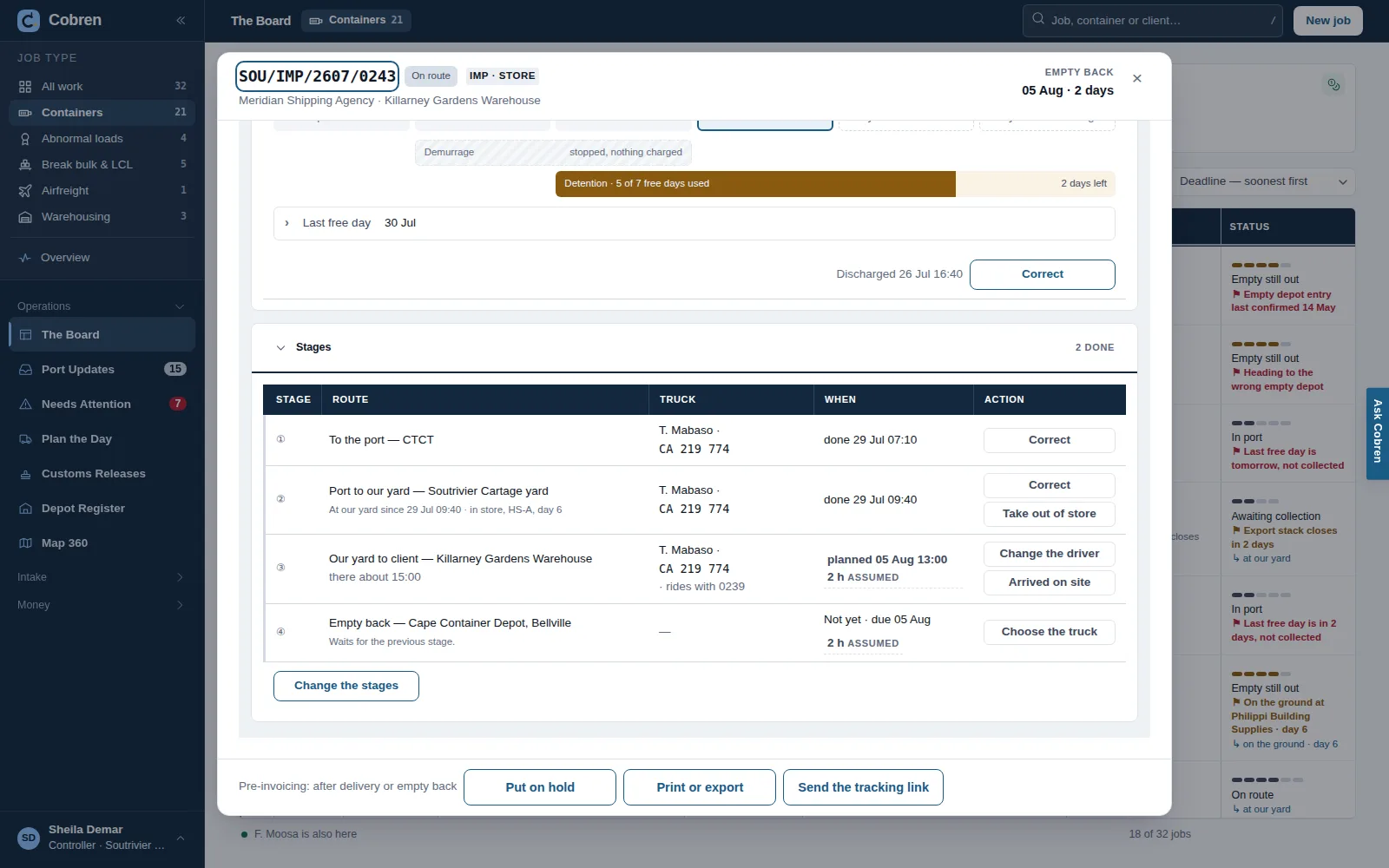
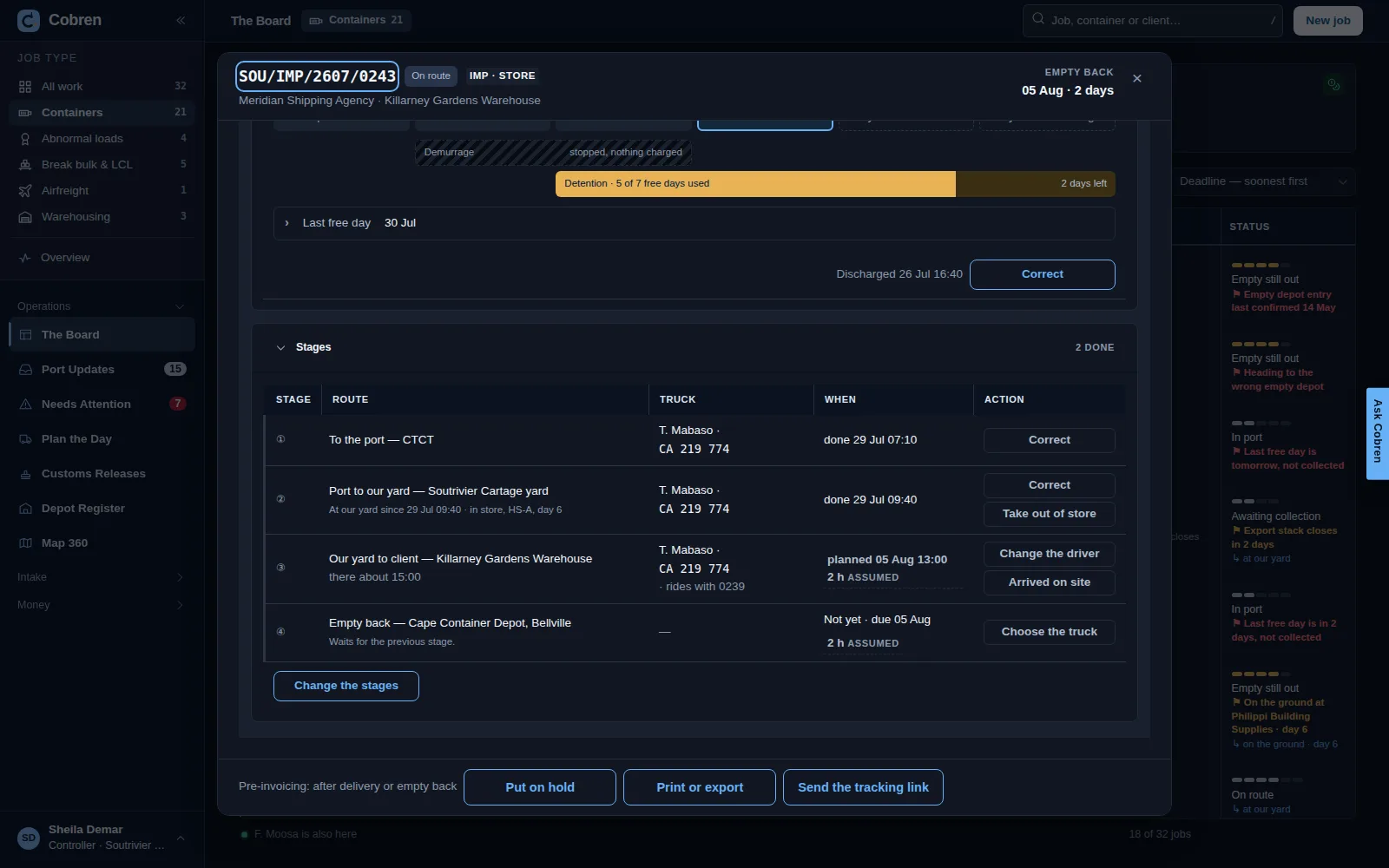
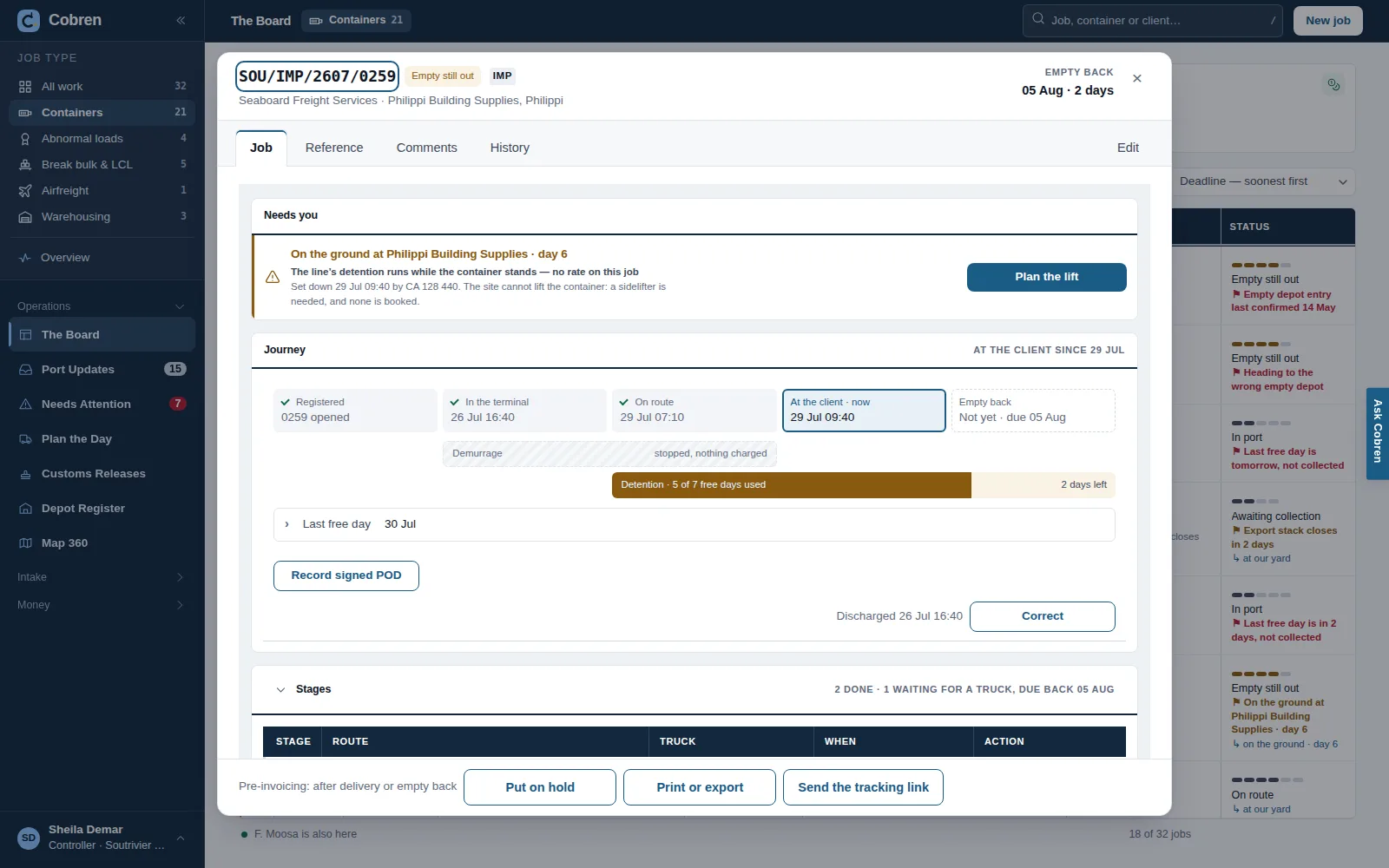
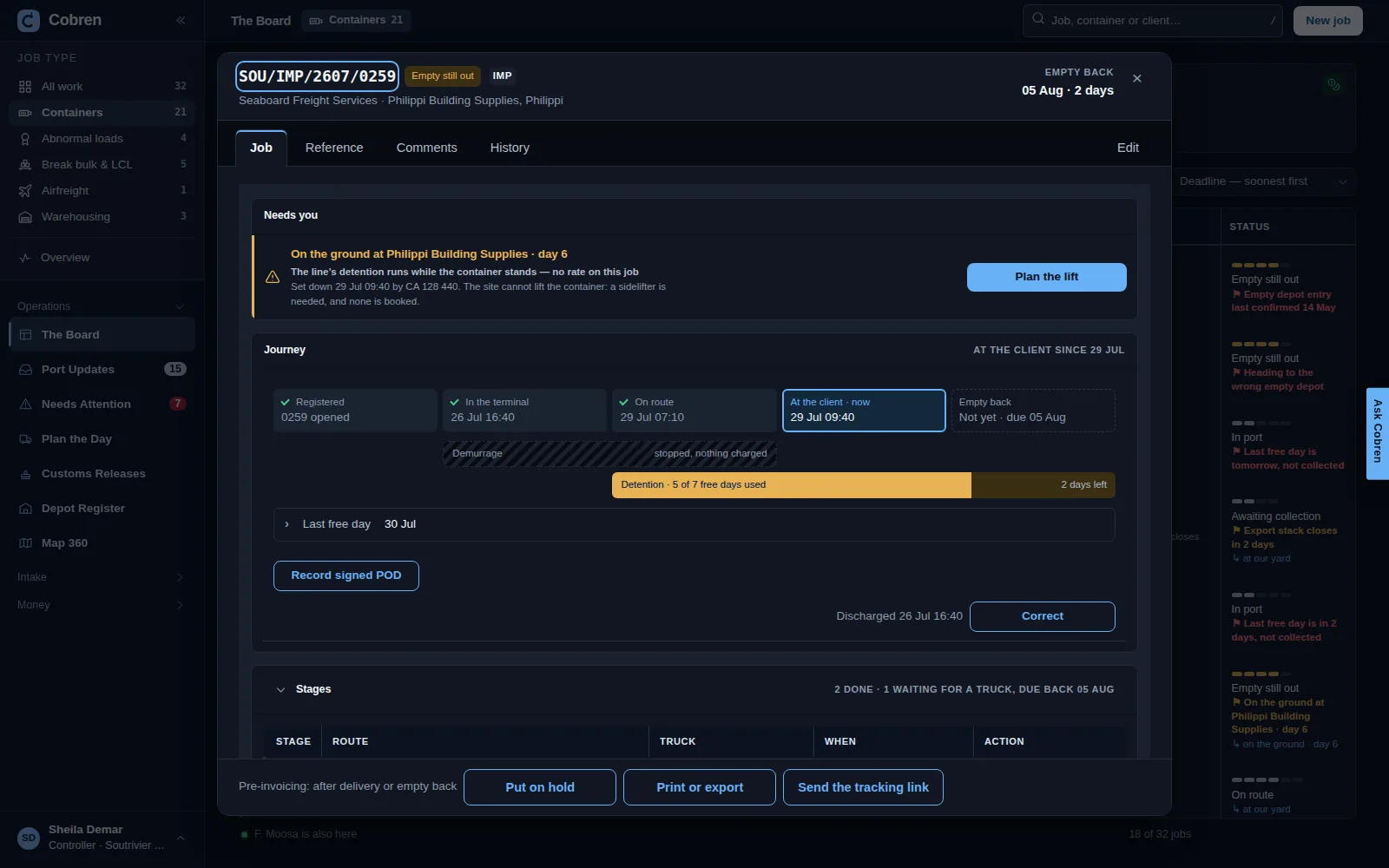
A place records what it can lift by itself — nothing, an empty, or a laden container. When a container is set down on the ground there, the job counts its days on the ground and the detention clock keeps running in plain view. Where the place cannot lift it, only a sidelifter may be put on the lift, and any other truck is refused by name. A sidelift fee sits on the rate card, per lift. Built in the application and tested; not live yet.
The bill of lading, the arrival notification, the customs release, the signed delivery note: uploaded at the desk or photographed on a phone, kept with the job, shown to your client or held back, withdrawn when wrong, and printed. A photograph that is taken back stays in the history with why. Built in the application and tested; not live yet.
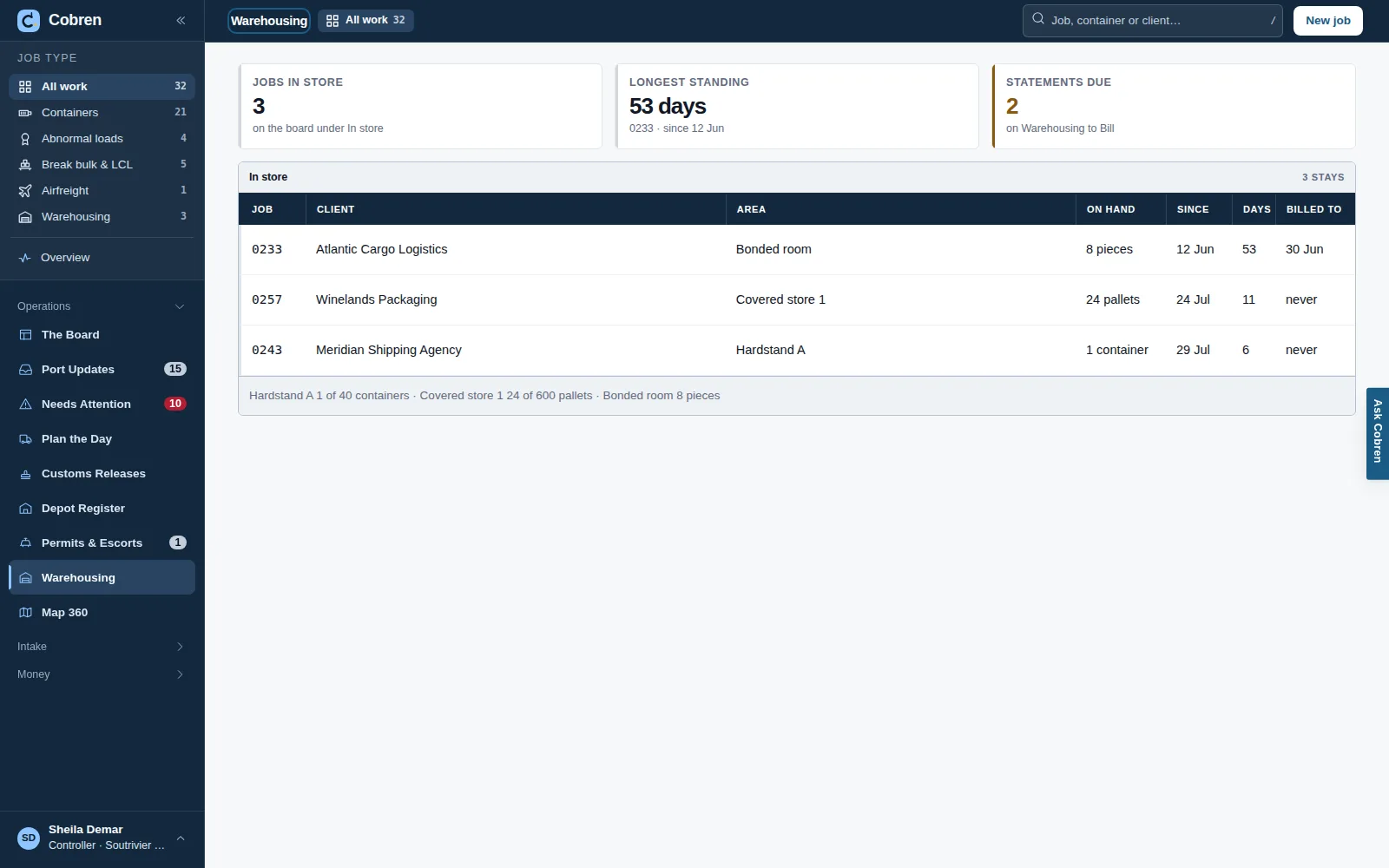
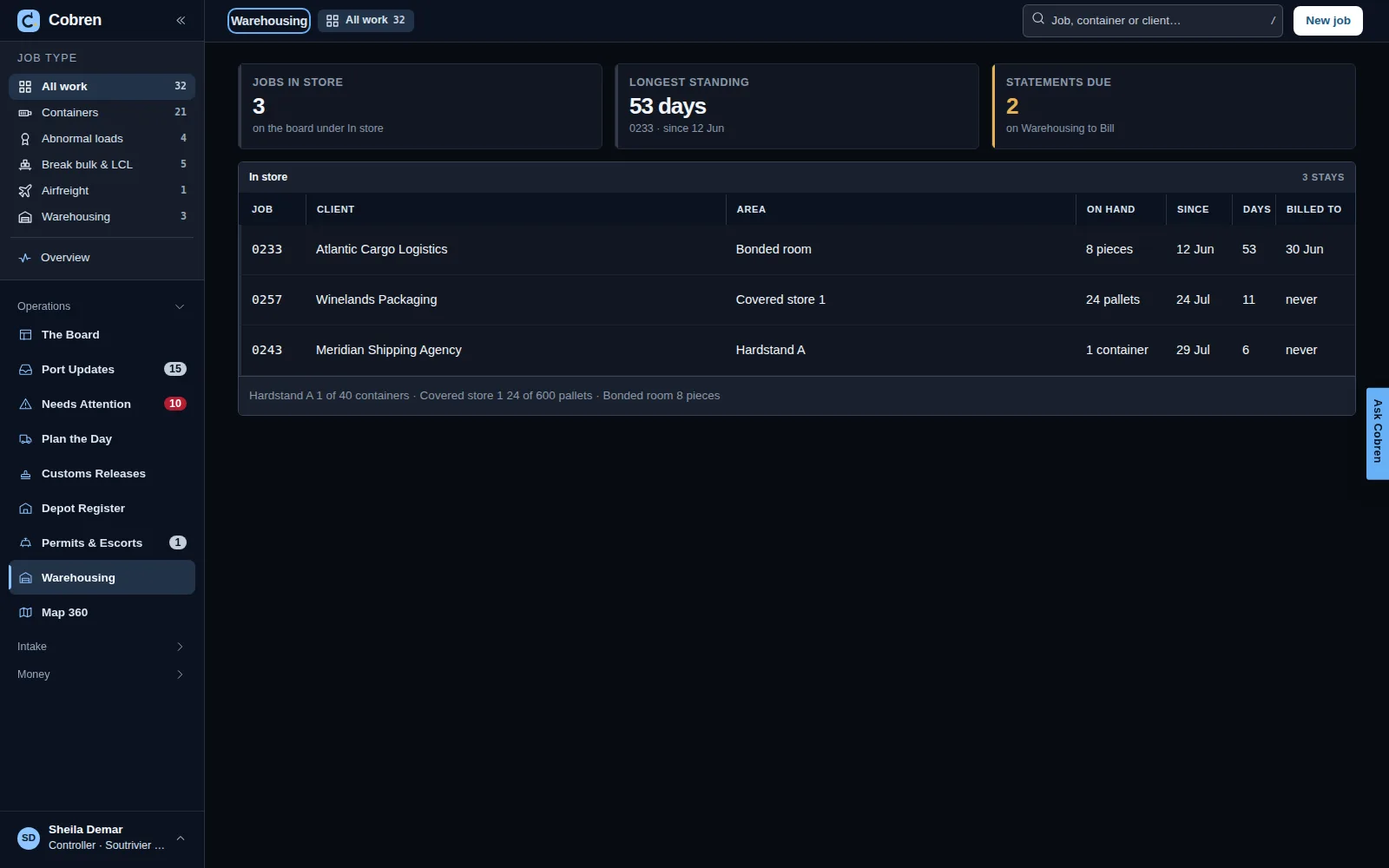
A job does not have to move. Goods or a container standing in your yard or your warehouse is a stay on a job: what is on hand, since when, and in which area. It is billed each month, or when it leaves. Warehousing shows everything standing; Warehousing to Bill shows what is owed, and a month that ended unbilled is flagged. Warehousing to Bill is built in the application and tested, not live yet; the Warehousing screen itself is in the prototype, on invented data — Phase 1.
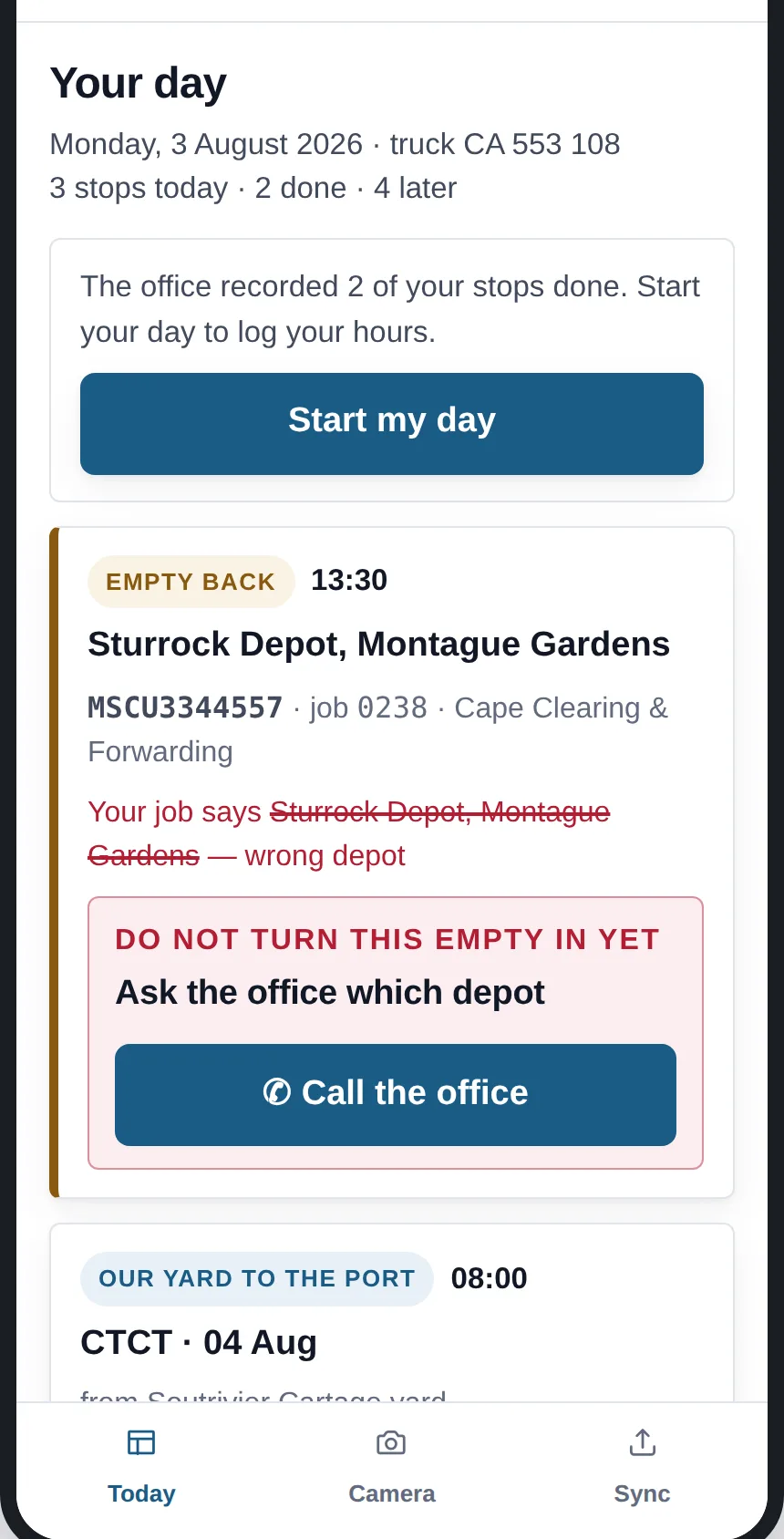
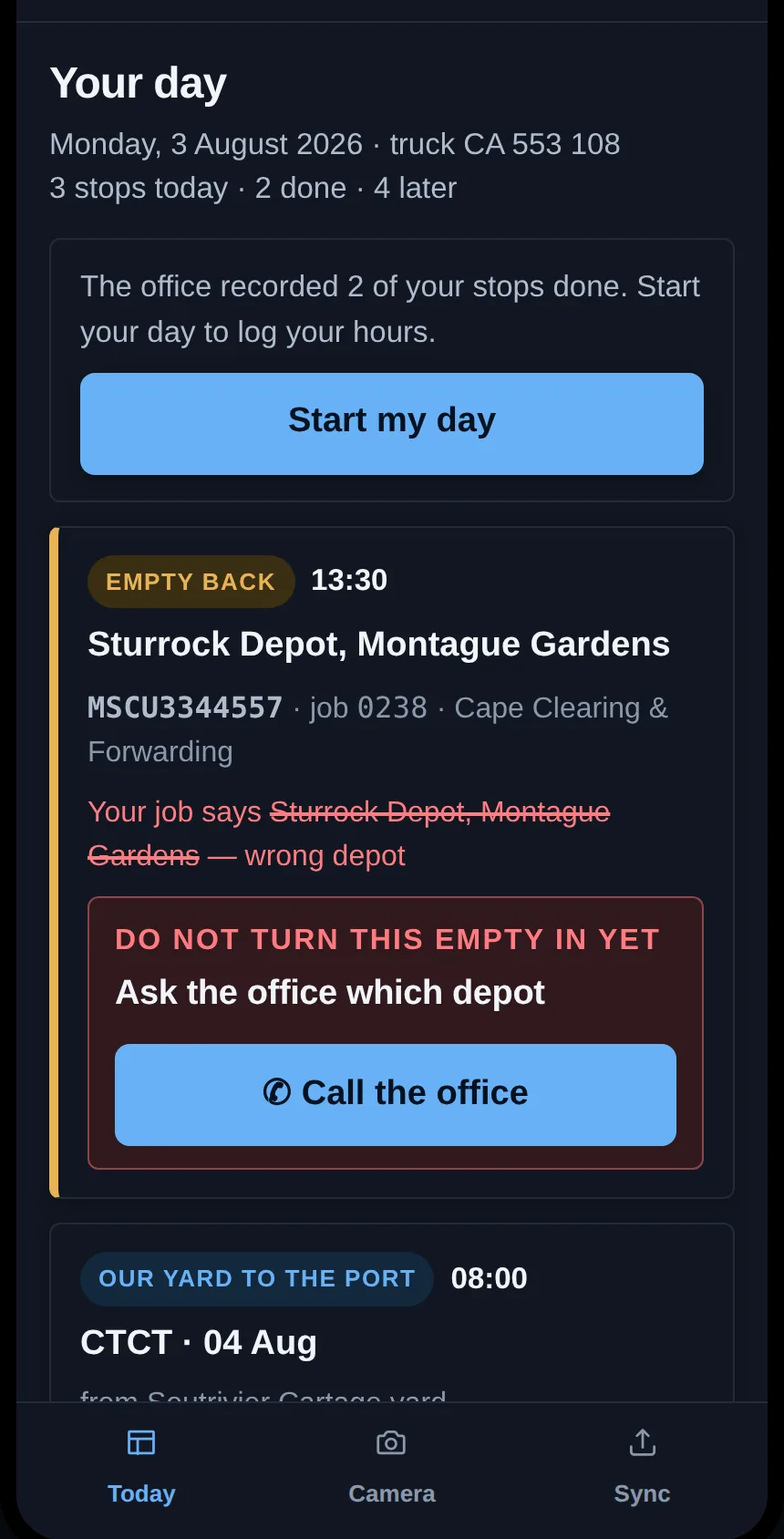
One web page in the phone’s own browser: no app store, nothing to install, and updates arrive by themselves. It needs Android 10 or newer with the current Chrome, or an iPhone on iOS 16 or newer. Built in the application and tested; not live yet.
Which phones it works on, and how to put it on the home screen
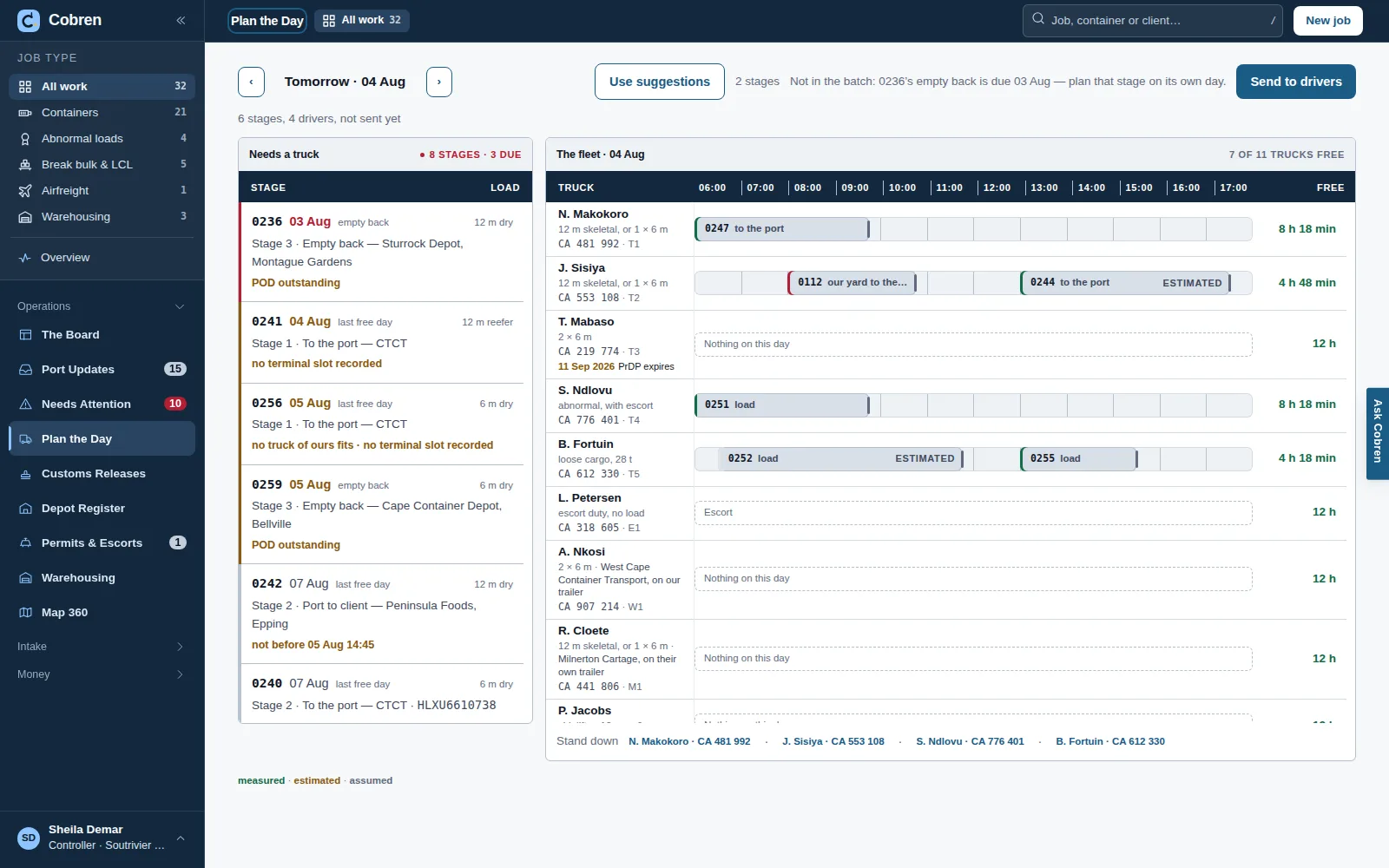
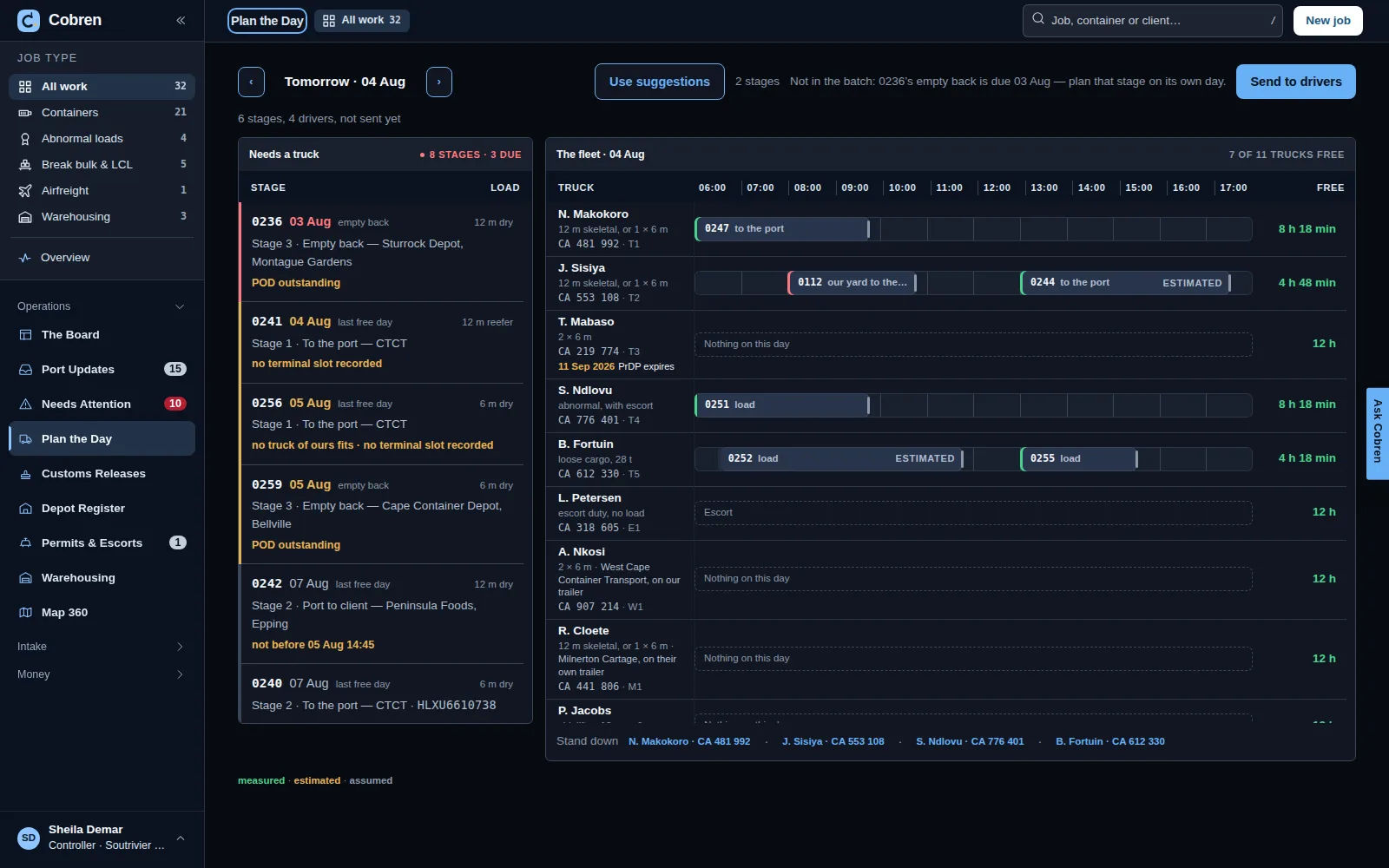
The day’s stages still needing a truck, next to your fleet. A person does the allocating; the suggested truck for every stage can be taken in one press. It refuses a clash and names it — and anyone who can allocate may overrule it, with the override recorded against their name. The screen is in the prototype — Phase 1; putting a truck and a driver on a stage is built in the application, not live yet.
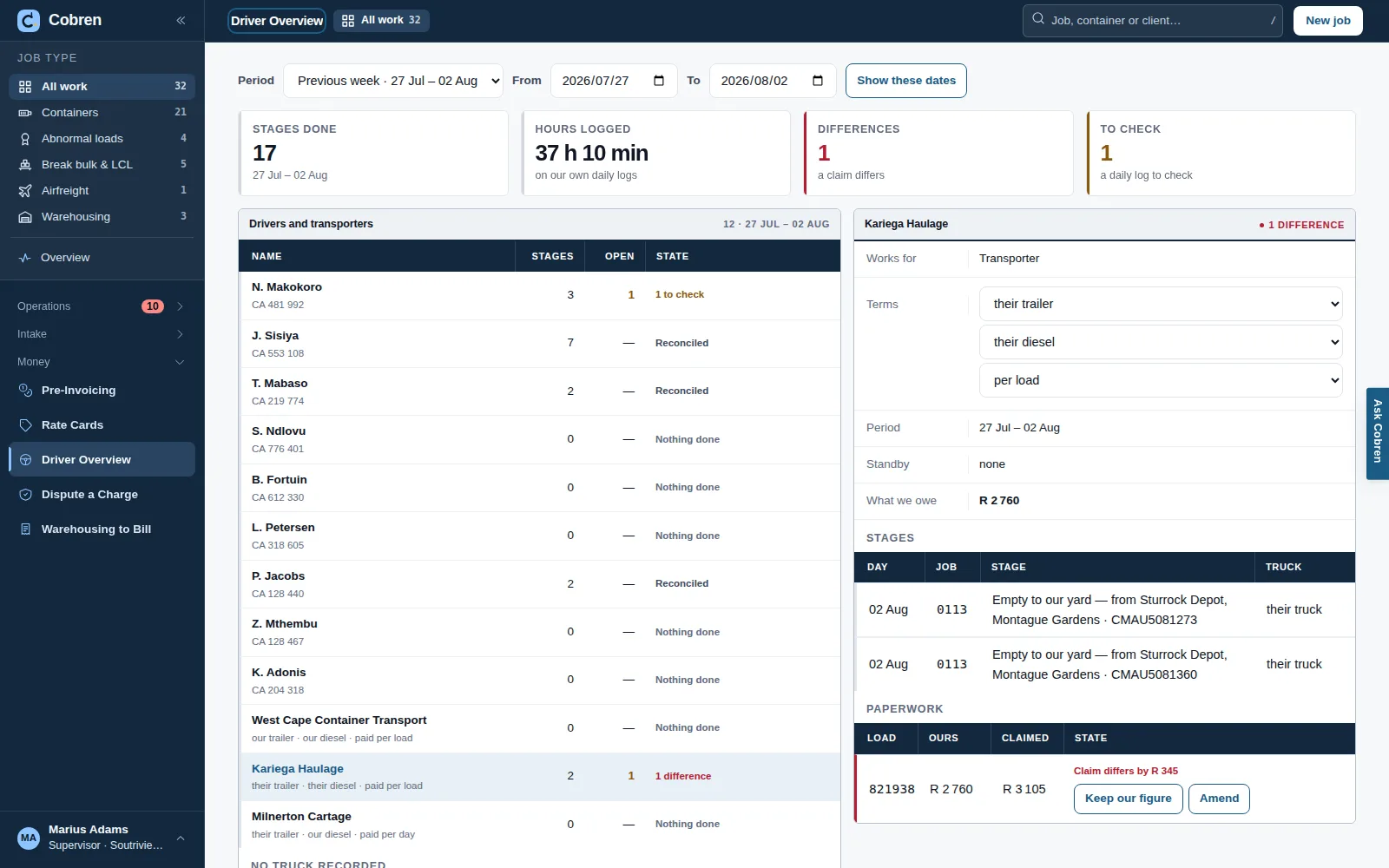
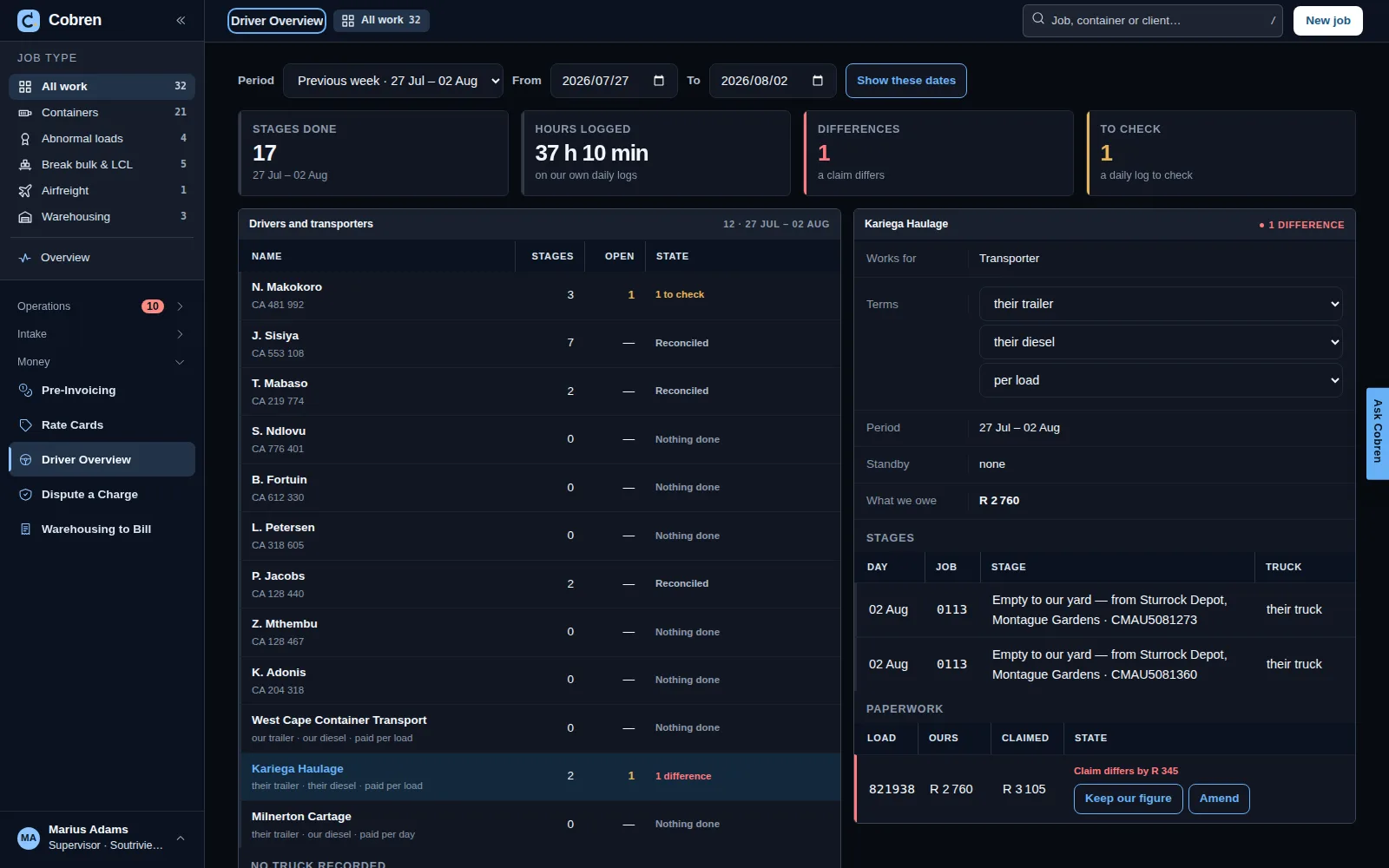
One driver of yours, or one subcontractor, over a week or a month: the stages done, the hours off the daily log, and each load confirmation beside what the subcontractor claimed. A difference is named, with the amount, and is settled one item at a time — the period is reconciled when nothing is left open. In the prototype, on invented data — Phase 1.
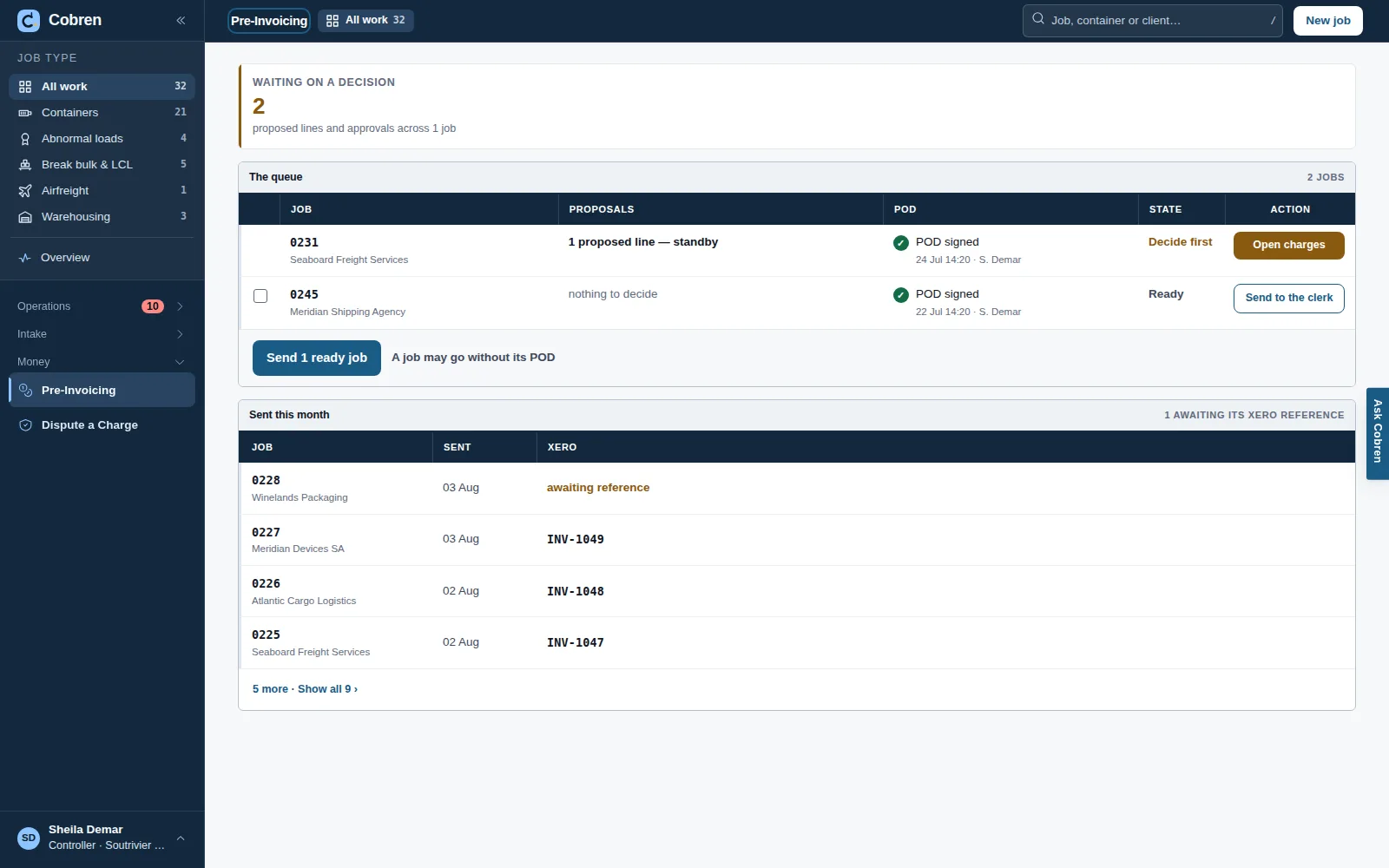
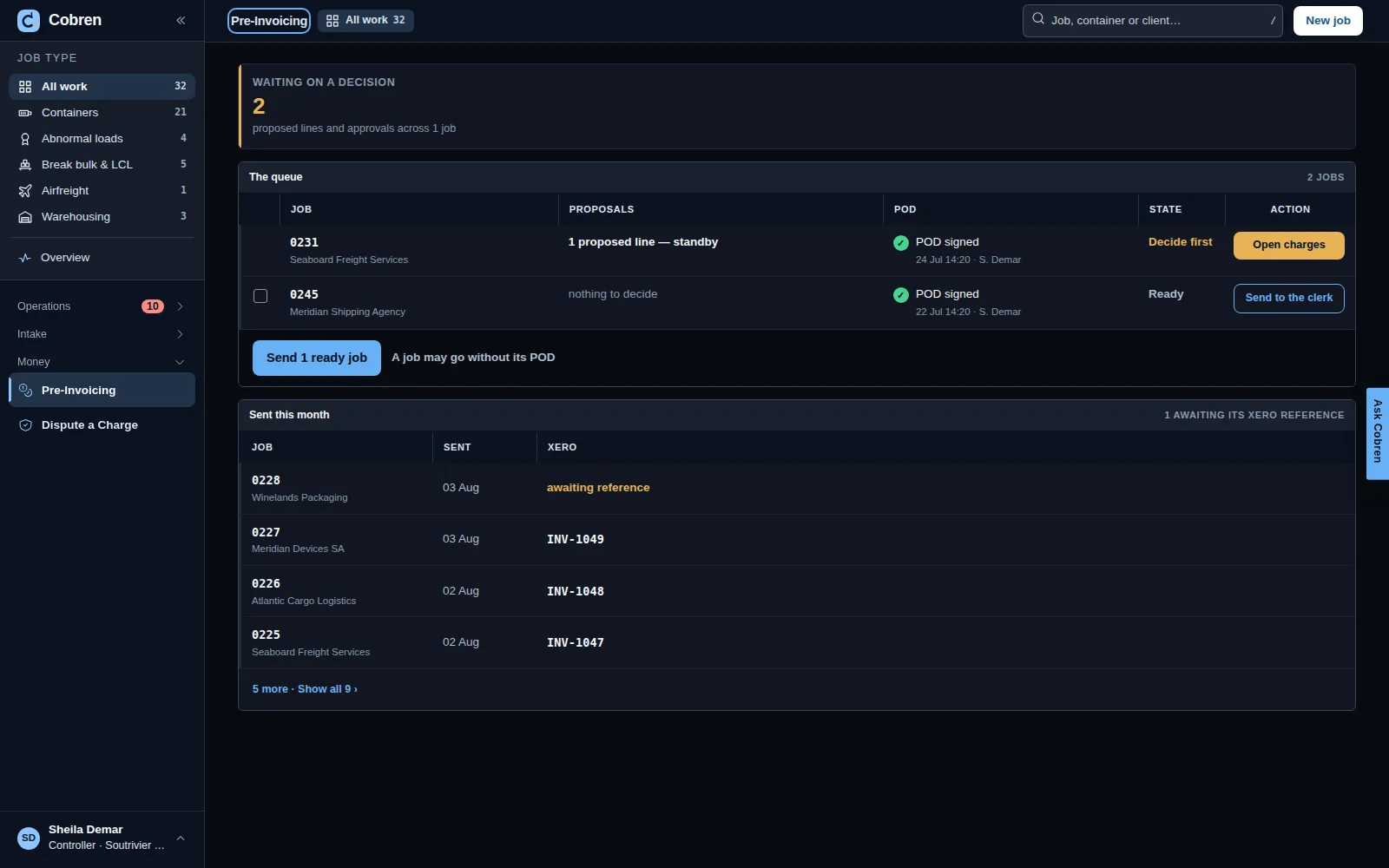
The client’s own rate card prices the job, or your company’s card where the client has no line. The job may agree a different price, and says which card line it came from; someone other than the person who priced it approves it. Pre-Invoicing is one queue of the jobs ready to bill, with what still needs deciding and whether the POD is signed, and VAT is worked out once, on the total. Once the pre-invoice goes to your invoicing clerk the price is frozen, and a correction is a credit note. Built in the application and tested against a real database; not live yet.
Going out, a subcontractor gets a load confirmation. It asks about their goods-in-transit cover before it is issued, and when their invoice comes in it is matched against ours, with any difference named and the amount beside it. Built in the application and tested; not live yet.
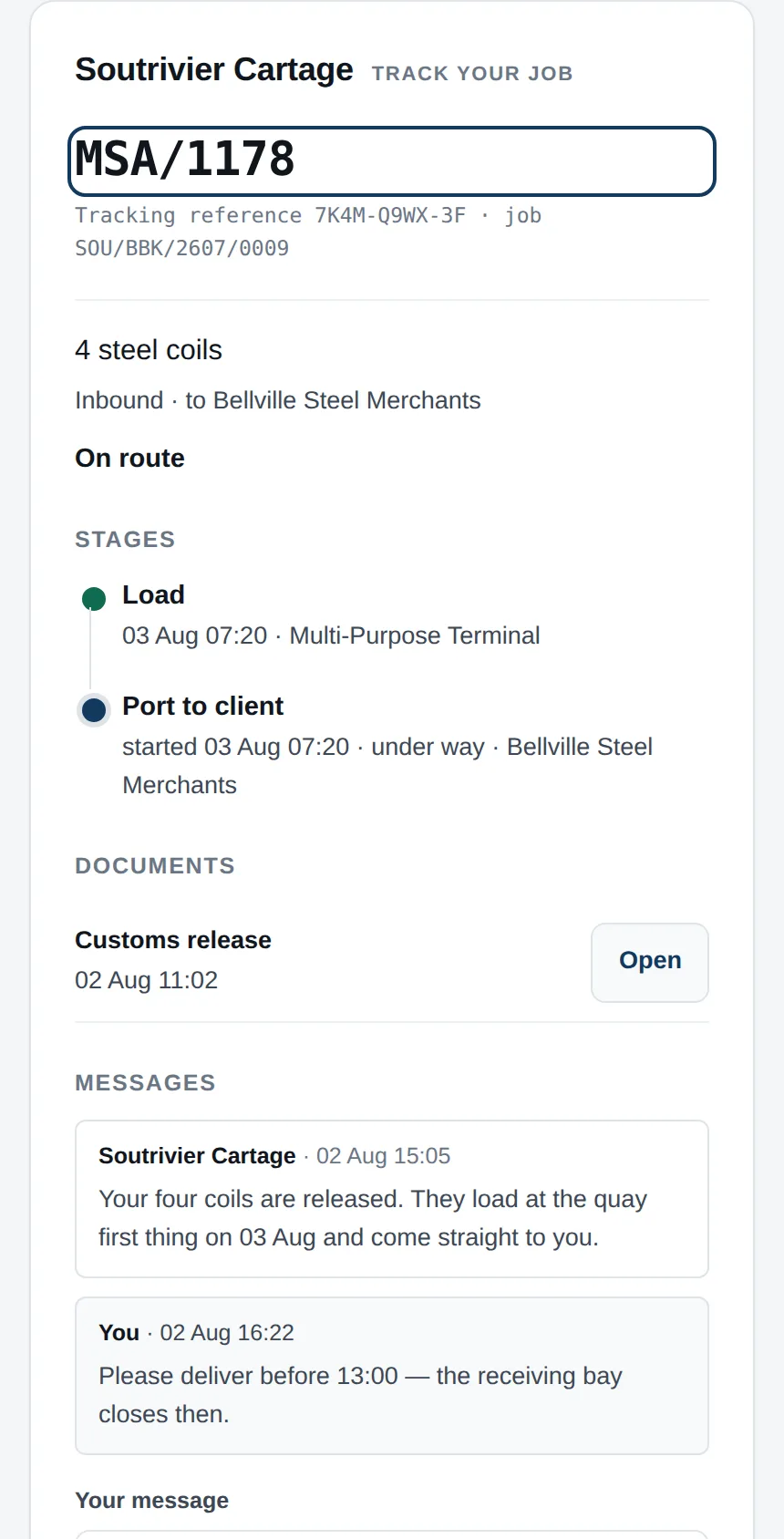
Like a courier’s: the office sends a job’s link to the people it chooses, by e-mail or WhatsApp, and only on a channel that person agreed to. The link shows that one job — its stages in plain words, the papers released to the client, and messages both ways — and needs no account. A client can send you a new job from a request link; it waits in External Requests until the office takes it on. A client you invite gets a portal of their own jobs and papers, signed into with Google or a password. Every e-mail carries “Stop these e-mails”, and only the client can undo it. None of it ever shows a price, a driver, a truck or another company. Built in the application and tested; not live yet, and no message has been sent.
Your company’s short name, then Google or your e-mail and password. Each time you sign in, Cobren greets you by name and says in one line what is waiting for you — the jobs that need you, what is due today and tomorrow, the port updates to decide, and the money at risk if you may see money — then opens on the screen your work starts from: the Overview for the owner, Pre-Invoicing for the invoicing clerk, the Board for everyone else. Built in the application and tested; not live yet.
Cobren reads a page you choose — a bill of lading, an arrival notification, your client’s instruction, a customs release — into the job’s fields, each beside the words on the page it came from. The depot and the last free day always wait for your tick, and nothing is saved until a person saves it. Only that page goes to Google’s AI in the EU, and your company can switch reading off. Ask Cobren, in the top bar, finds the answer in help written by people; it never reads your jobs, and when nothing answers it opens an e-mail to Cobren support with your question. Built in the application and tested against a stand-in model; not live yet, and Google’s model has not read a page — its first test on real papers runs on staging.
03 · Where we are
A prototype is a design. Here is the line between what is written and tested, what is being built now, and what is only drawn.
04 · Security and POPIA
Where your records will live, who can see them, and how long they are kept — then what this website does with you, which is nothing.
It will be kept in Google’s Johannesburg region (africa-south1); nothing runs there yet. Under POPIA your company is the Responsible Party and Cobren is the Operator, working only on your instructions. Reading a page with AI is the one step that will leave the country, because Google offers no AI model in Johannesburg: only that page goes, and you can switch reading off. You get the list of every company that handles your data before you send us your first document.
Every record carries your company’s mark, and the database itself refuses it to anyone signed in to another company — not only the screens. Tests prove the wall on a real database in every build.
A job’s record is kept five years after its last invoice, by default. Then the personal details on it are blanked — the record of what happened stays, and the blanking is recorded too.
Who recorded what, and when, is kept. A mistake is corrected or taken back, never rubbed out, and the history shows both.
A tracking link shows one job; the portal shows a client’s own jobs and the papers you released. Neither ever shows a price, a driver, a truck or another company.
There is no form on this site, no analytics script, no advertising pixel and no cookie. Nothing you do here is recorded by us — the host sees the request, as any host does, and we never look at it.
The typefaces, the pictures and the page itself are served from cobren.io. Your browser asks no other company for anything while you read it — the page’s security policy forbids it to.
If you switch the theme, that choice is kept in your own browser's local storage. It is never sent anywhere and we cannot read it.
Mail to janno@cobren.io is kept in Cobren's Google Workspace mailbox, so Google handles your message. We keep what you send us for as long as we are talking, and delete it within twelve months of the last message unless you have become a customer and it belongs to the file.
Cobren is a sole trader registered in the Netherlands, and Janno Mostert is the person responsible for it. This page is served by Cloudflare, which sees your IP address the way any host sees it; nothing else about your visit is recorded, and we receive none of it. To ask what we hold about you, or to have it deleted, email janno@cobren.io. We will answer within 30 days, which is the period the GDPR allows. Last updated 5 October 2026.
05 · Pricing
Prices exclude VAT. Cobren is being built now — not live yet; this is the price when it goes live.
A truck counts in a month when it does at least one job in Cobren that month. A parked truck costs nothing.
Give everyone in your office a login and move as many containers as you like. Neither changes the price.
A link to your accounting system or a tracking feed is quoted for you, on top. That is why the truck price is “from”.
One product, nothing to upgrade to. Reading pages with AI, once it is live, is in the same fee: no credits and no meter.
Ten trucks that each did a job this month: R3 000 + 10 × R500 = R8 000 for the month, before VAT. Tell us how many trucks you run and what you would want Cobren linked to, and we’ll send you your price in writing.
06 · Talk to us
We are looking for a small number of South African container transporters to build this with. If that is you, the fastest thing is a conversation.